
Alicia Anne Tymon-McEwan
Email: A.A.Tymon-McEwan@liverpool.ac.uk
Institution: University of Liverpool
Supervisor: Dr Marco Iuliano
Thesis Title: Pedagogy of the Project, 1894–1968: Venice, Liverpool and Cambridge (Mass.)
Thesis Summary: My dual training as an architect and an archaeologist has enabled me to traverse academic boundaries, contributing equally to contemporary design exhibitions [drive.google.com], editorial dissemination [drive.google.com] and the rigorous analysis of theoretical, historical, ancient, and vernacular heritage. In recent years, my work has principally unfolded between Italy and the United Kingdom, where I have sought to foster mutual cultural exchange through bilingual research projects.
The project I now undertake examines the pedagogy of three schools of architecture — Venice, Liverpool and the Harvard School of Design (Cambridge, Mass.) — during a crucial historical moment: the transition from Beaux-Arts traditions to Modern principles. The advent of Modern architecture in the early 20th Century, and the gradual fading of Beaux-Arts sensibilities, represents one of architecture’s most paradigmatic shifts. Despite this, the Beaux-Arts approach to teaching remains widely recognised as the foundation of formal architectural education. Due to a reluctance to engage with pedagogical history, architectural scholarship confronting the evolution of these teaching methods remains scarce. Studying the three schools together enables a comparative analysis of how different institutional cultures negotiated the same pedagogical transition. Such research is essential to understand current educational practices, with scope to enliven each schools’ educational offering in the present.
As the discipline of architecture seeks to reconcile its artistic heritage with the technological skills of the future, this research confronts how the education of an architect can negotiate a period of disciplinary uncertainty. Drawing on my experience of exhibitions as tools for researching and teaching, I intend to complement archival investigation with curatorial projects and workshops that engage architectural students and educators with these historical materials. The project therefore brings architectural history into dialogue with present-day educational practice, exploring how the study of past pedagogical models might open new possibilities for the education of future architects.
Amber Ó Laoghaire (née Alker)

Email: amber.r.olaoghaire@durham.ac.uk
Institution: Durham University
Supervisors: Professor Katherine Puddifoot, Dr Alison Lane, Dr Roslyn Malcolm
Thesis Title: How the Mind Body Dichotomy in Medicine Creates Epistemic Injustice in Functional Neurological Disorders
Thesis Summary: This project examines how clinicians, patients, and the public conceptualise “functional” disorders, and how epistemic injustice shapes the illness narratives and diagnostic experiences of people with Functional Neurological Disorders (FND). Clarifying the conceptual resources that are available—and those missing—may improve diagnostic communication and strengthen patients’ therapeutic self-understanding. Beyond FND, a humanities-informed re-examination of functional disorders may help challenge mental health stigma, address the effects of rigid divisions between mental and physical health services, and support more integrated biopsychosocial approaches to illness.
The project will also aim to also recontextualise epistemic injustice in functional disorders more broadly. Existing accounts often frame a tension between patient and clinician testimony: patients emphasise the physical reality of symptoms, while clinicians point to the absence of structural pathology or the role of psychological mechanisms. I argue that these perspectives need not be opposed. Rather, their apparent conflict reflects the persistence of the mental–physical dichotomy and limited shared conceptual frameworks for functional disorders.
Research Interests: Epistemic Injustice; Functional Neurological Disorders; Embodied Cognition and Neuroscience; Narrative Experience of Illness and Disability; Harms of Mind-Body Dualism in Medicine
Academic Journal Article:
- Alker, A. (2025). Talking About the Taboo: How Perceptions Regarding Women’s Health Inform Cognitive Behavioural Therapists’ Practice with Women Experiencing Chronic Pelvic Pain. The Cognitive Behaviour Therapist. DOI: 10.1017/S1754470X25100342 https://www.cambridge.org/core/journals/the-cognitive-behaviour-therapist/article/talking-about-the-taboo-how-perceptions-regarding-womens-health-inform-cognitive-behavioural-therapists-practice-with-women-experiencing-chronic-pelvic-pain/0519DCB60917D534E6806961348BBF03
Articles in a Peer-Reviewed Clinical Magazine:
- Beddows, A., Alker, A., and Tribe, S. (2025). ‘We Speak Up’: White Ribbon Day and Gendered Inequalities in Healthcare. CBT Today, 53(4).
- Alker, A. (2023). Disability and Gender. CBT Today, 51(3).
Public-Facing Blog Posts:
- Alker, A. (2023). Carers Week. Suffolk Wellbeing. https://www.wellbeingnands.co.uk/suffolk/blog/carers-week/
- Alker, A. (2023). Endometriosis Awareness Month. Suffolk Wellbeing. https://www.wellbeingnands.co.uk/suffolk/blog/endometriosis-awareness-month/
- Alker, A. (2022). Disability History Month. Suffolk Wellbeing. https://www.wellbeingnands.co.uk/suffolk/blog/disability-history-month/
- Alker, A. and Chisholm, J. (2022). Black History Month. Suffolk Wellbeing. https://www.wellbeingnands.co.uk/suffolk/blog/black-history-month/
- Alker, A. and Chisholm, J. (2022). LGBTQ+ Pride Month. Suffolk Wellbeing. https://www.wellbeingnands.co.uk/suffolk/blog/pride-month/
Ann Copeman
Email: ann.e.copeman@durham.ac.uk
Institution: Durham University
Supervisors: Professor Douglas J. Davies, Dr Teti Dragas
Thesis Title: Ritual, Symbolism, Embodiment, and Relational Health: Ecologies of Gardening Practice
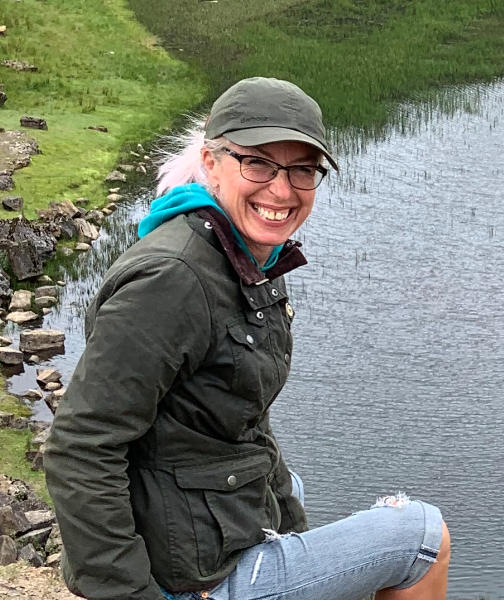
Thesis Summary: Following a career in landscape gardening, I am working with gardeners and in community gardens to explore how personally meaningful narratives can arise through the practical activities of growing, harvesting, caring, and sharing in relation to garden ecosystems. This project combines participatory ethnographic research and digital storytelling methodology with a theoretical approach founded in ritual-symbolism, embodied practice, relationality, and ecological epistemology. I am interested in the ways knowledges emerge through bodily practices, and how people’s relationships with the garden’s dynamic processes and beyond-human agencies interact with their understandings of health, illness, and wellbeing in the world.
Keywords: Community Gardening; Nature/Ecology; Ethnography; Creative Methodologies; Health & Wellbeing; Religions & Spirituality
Asmaa Abulatifa
Email: a.abulatifa@lancaster.ac.uk
Institution: Lancaster University
Supervisors: Dr Lindsey Moore, Dr Philip Dickinson
Thesis Title: Palestinian Prison Literature and Carceral Cultural Production: Writing, Resistance, and Geographies of Confinement
Thesis Summary: Through the lens of Palestinian prison literature, My PhD examines how incarceration extends beyond the prison cell into a broader landscape of occupation, territorial fragmentation, surveillance and ecological disruption. Building on settler colonial studies, carceral theory and ecocriticism, this project analyses 21st century Palestinian works ranging from fiction, memoir, testimonial writing and cultural production to investigate the interconnected spatial, environmental and existential dimensions of confinement. Through close textual analysis, historical contextualization and interviews with Palestinian writers, scholars and activists, I aim to explore how prison literature functions as a critical archive of Palestinian experiences of dispossession and a form of literary resistance, challenging dominant narratives of occupation and exposing the relationship between carceral power, environmental harm and the struggle for Palestinian liberation.
Research Interests: Palestinian Prison Literature; Carceral Geography; Settler Colonialism; Ecocriticism; Literary Resistance
Publications: Coming soon!
Austin Woerner
Email: qgnx0398@leeds.ac.uk
Institution: University of Leeds
Supervisors: Professor Kimberly Campanello, Dr Sarah Dodd
Thesis Title: Redreaming the Red Chamber: A New English Translation of the ‘Great Chinese Novel’
Thesis Summary: My practice-led PhD centres on creating a fresh, readable, modern English translation for Cao Xueqin’s Dream of the Red Chamber (written c.1740-60, also known as Story of the Stone), a novel of enormous cultural importance in the Chinese-speaking world but largely unknown among English speakers.
Renowned for its literary artistry, Dream of the Red Chamber is often called ‘the Great Chinese Novel’ and compared to the works of Proust and Tolstoy. But unlike such works of world literature, it is read in English primarily as a cultural artifact of interest to scholars in Chinese Studies, rather than as a work of art engaging universal human themes.
My project explores whether a new approach to translating Dream could allow Anglophone readers to better appreciate the literary qualities that Chinese readers so admire in the novel. To achieve this, I employ an “open studio” method in which I co-create my translation in dialogue with readers. In doing so, I seek to understand the place Dream holds in the Chinese cultural landscape and the Chinese psyche, the better to mediate between the work’s Sinophone and Anglophone audiences.
My Substack on Dream of the Red Chamber: https://redreaming.substack.com/ [redreaming.substack.com]

